Sunday, February 19, 2012

Catalinas at Rathmines


My brother, Barry, has just become a resident of an aged-care facility at Rathmines, so I shall be visiting the area on a regular basis throughout this year. It has a fascinating history, so I shall try to relate some of it to you.


These photographs were taken on my very first visit to the facility when I tried to assess what I liked and what I did not like. Afterwards, I walked around, and all these shots were taken within 250m of the aged-care home. For example, the two images above show remaining RAAF 'huts' from the period. They are sort-of used by the Christadelphian Church, but enthusiasts are trying to raise money to reestablish a semblance of a Catalina base. The other shot shows the concrete apron up which the Catalinas were 'dragged' when they required an overhaul.


The area is dotted with information boards that explain what used to be there, or why the landscape is what it is. I shall get to these in time. To get to the Rathmines shop from the home, I have to walk through the sporting fields originally established by the RAAF. They had lots, but the base could house thousands of young men and women at any given time.
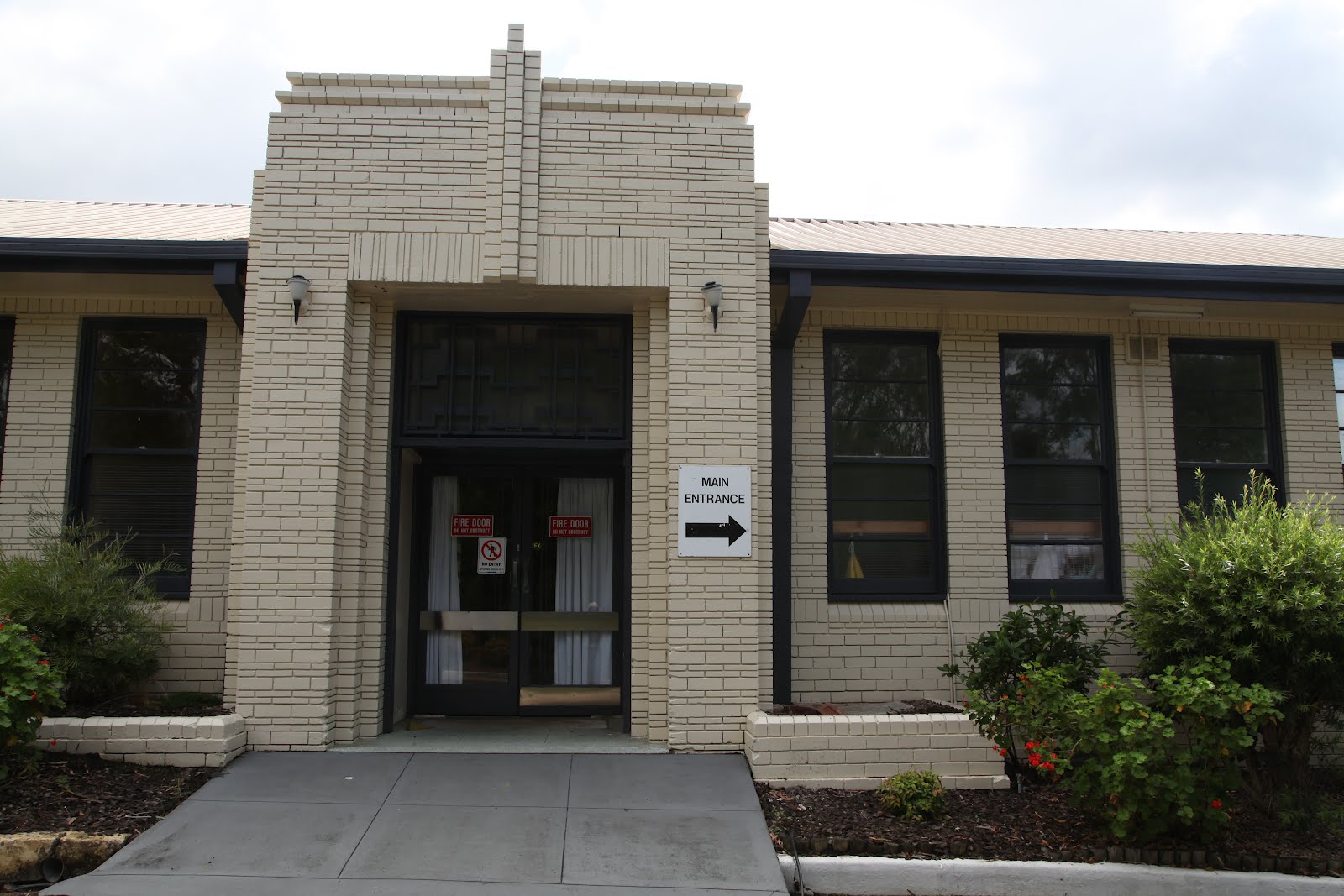

The aged-care facility started life as the hospital and dental care wing of the base. It was a simple one wing building. You see the quaint art-deco design of the era in the shot above. After the base was decommissioned, this became a private hosptial, and then the nursing home. The nursing home is high-care and dementia-secure only. The other shot above is a view of the nursing home from the concrete apron.

There is one building, down on the waterfront, which is madly being renovated to remove asbestos. A sign of those times, I guess.

Thursday, January 5, 2012

Decisions, decisions


I have spent a week agonising over this decision, only to come full circle.

I wanted to change this blog to one about Wauchope, because I will know the place well by the end of 2012. Then, I thought to change this blog to cover other small towns that I visit, not just in NSW, but anywhere really.

Then, my biggest and bestest brainwave: I would start a blog based on the video at the beginning of this post. This video was made in the Winter of 2008 sitting on a bench at the Milson's Point end of the harbour bridge, looking back to the opera house. My father had a number of party pieces, this was one of them. However, I counted the number of railway towns Dad mentioned, and instead of the obligatory 50, he only mentioned 38. What Bertie Witherspoon had done, was to teach his boys the towns along each track line: Main Southern, Main Northern, Main Western, South Coast Line, North Coast Line, and Broken Hill line.

However, to do the blog properly, I would need to travel to each town, get off and document the town. What if the train does not stop there amymore? It would mean that I have to stay in 50 country towns, for one or more nights. If I did one trip per month, it would take me just over 4 years.

I will mull ont it some more.

Monday, December 26, 2011

Wauchope - Fuels & Oils


When I visit my brother, Barry, in the nursing home, I usually only stay for about an hour. Any more is very wearing for both of us. I then go for a meander for two hours, and come back for another hour visit. I do this on consecutive days.

So, I was meandering, sans map, and found this little gem on the quiet end of Hastings Street. It is a store like this that pulls a city slicker up with a thud! It is a petrol station. It is a garage. But it is more. It is one of the essential types of small business that are the life blood of a country town: the stock and station agent; the grain store; the saddler; the veterinarian. They do things differently on the land.


Look at that facade. Reminds me of the drawings of houses that 5 year olds come up with - a bit face-like. For some reason, this store-front reminds me of that old film by Peter Bogdanovich called 'The Last Picture Show'. Can't think why. Something lurking in the deep recesses of my poor brain. Which reminds me, and the link is tenuous: I saw "The Iron Lady' over the break. Streep is remarkable, and it annoys me that Margaret & David said she was 'impersonating' Thatcher. What else does an actor do, but impersonate? But, there was something that gnawed at my poor old brain again. I tend to think the script was inadequate. Does that sound like I'm up myself?

Streep was excellent, as was Broadbent. As were the pair of young actors who played (impersonated) young Maggie and Denis. And I did not pick up that it was biased, either to the right or to the left. But it was nearly all from the perspective of the demented 85 y.o. Thatcher. And I am not sure how accurate that point-of-view can be. How can anyone be sure what is going through the mind of someone with dementia? I think I kept on wanting it to get on with the bloody story. Let's have some barricades, and blood on the streets. Well, there were the two bombings ...

Nothing to do with Wauchope ... but ... it came into my head ... early signs ... perhaps?

Saturday, December 24, 2011

The derision of a 'tidy town'


I guess it is the 'inner city elites' often known as 'latte sippers' who sniff their noses up when driving through a country town in Australia that is as neat as a pin. They are known as 'tidy towns' because of an annual competition run by the 'Keep Australia Beautiful Council'. To the best of my knowledge, neither of these towns has won the title of a 'Tidy Town'. However, to my inner-city jaded sensibility, both Jamieson in Victoria and Wauchope in New South Wales would seem to qualilfy.


According to Wiki, The Keep Australia Beautiful Council is a not-for-profit environmental conservation organisation founded in Victoria in 1969. It is established now in every state and territory, and is jointly funded by both State and Federal governments. The KAB Council runs the 'Tidy Town' competition.


The Tidy Town awards encourage, motivate and celebrate the achievements of rural and regional communities across Australia. Originally focussed on litter reduction and civic pride, they now address the environmental, social and economic sustainability of local rural communities. There is a state winner each year, and an overall national winner.


I suspect there is a quota system at work in the winners list - a bit like the Nobel Prize for Literature. Each state seems to be equally represented in the list of past winners:
1991 Mount Tyson, Queensland
1992 Mount Gambier, South Australia
1993 Forbes, New South Wales
1994 Lucindale, South Australia
1995 Naracoorte, South Australia
1996 Kiama, New South Wales
1997 Stanley, Tasmania
1998 Denmark, Western Australia
1999 Goolwa, South Australia
2000 Batchelor, Northern Territory
2001 Horsham, Victoria
2002 Soldiers Point / Salamander Bay, New South Wales
2003 Wyalkatchem, Western Australia
2004 Port Vincent, South Australia
2005 Mount Gambier, South Australia
2006 Collie, Western Australia
2007 Swansea, Tasmania
2008 Toowoomba, Queensland
2009 Tamworth, New South Wales
2010 Beechworth, Victoria
2011 Lithgow, New South Wales


I think there was some political fall-out from the selection of Lithgow as the national winner for 2011. Something to do with under-handed, skulduggery in the workings of local councils. Really!


The first six images here were taken in Jamieson, Victoria at the end of November this year. The second six images were taken in Wauchope, NSW at the beginning of December this year.

Sunday, October 2, 2011

Beechworth - The Diggings


Touted as a grand drive through the diggings of a bygone era, I found the gorge to be rather sad and forlorn,, emphasising the destruction of the natural environment to man's insatiable greed.

This hand picked and sawn race flows under Newtown Bridge. This bridge, on the eastern outskirts of Beechworth, started operation in 1875. Using no mortar whatsoever, it is held together with keystones.

Louis Chevalier set up a water-powered saw mill using water from this race in the middle of 1853. Later it was converted to grind flour, but ceased operation totally in the 1880s.

This entire gorge is very sad. All I can envisage is hordes of men, who failed at city jobs, desperately digging to try to make ends meet. Pounding the sides of this gorge into mountains of detritus and pock-marks.

Tuesday, September 27, 2011

Beechworth - the old hospital


I did not feel engaged by the historic end of the town, but was more engaged up this end of town.

Originally called the Ovens District Hospital, it was completed in 1857 and demolished in 1940. Let's put its construction into context. The Victorian gold rush is considered to have been from 1851 until the late 1860s. Ned Kelly was born in 1855 and hung in 1880. My great-great-grand-father, Stephen Cole, settled in nearby Jamieson in 1862.


The first stage of the hospital cost 2,347 pounds. Even though another hospital was built in Wangaratta in 1871, further additions were made to this hospital in both 1858 and 1890. The hospital was demolished in 1940 when a new, smaller one, was built. Due to the shortage of building materials during World War II all salvageable materials were used for public works within Beechworth. All that remains of the 1857 hospital today is the granite facade, and remnants of the extensive gardens.


Even here, an opportunity has been lost. Down in Port Arthur the impact of the historic site has been magnified by snippets of the lives of the convicts and others who existed there. This hospital, too, would have a greater impact if we could stand and read about some of the miners and pioneers who benefited from its existence.

Sunday, September 25, 2011

Beechworth - Echoes of History


My first visit to Beechworth was in 1972. Yes, nearly forty years ago. So, it stands to reason, that things will have changed in the interim: the town will have changed; and, I will have changed.

And the way history is perceived and presented has changed.


In the year 2000, I gather, a sizeable amount of government funding was dedicated to Beechworth, to enable its story to be preserved for future generations. The tagline, 'Echoes of History', is the public face of this programme.

The result is a sterile, bureaucratisation of a provincial town. I guess it was either that or history as a 'reality show'. Needless to say, I was gobsmacked and disappointed. But I will be the first to say that I have changed equally as much as Beechworth has changed.


In my mind's eye, I had visions of a tumble of junk, of dirt, of old people with flowing beards working in blacksmith's shops, of slabs of decaying wood roughly joined together into huts. Was this what Beechworth had been in 1972? I am no longer sure.

But Beechworth today is fit for the busloads of senior's groups who are plonked down in the main street for an hour or so, and who spend their time in gift-shops and bakeries.

Friday, September 23, 2011

Myrtleford - Tobacco growing


I did not realise that tobacco was a viable crop in Australia. The number of smokers in our community is down in the low 20%. All the major cigarette manufacturers are multi-nationals. Somehow I figured that all cigarettes were manufactured off-shore. However, when I think of it, in the late '30s and early '40s my mother packed Craven A cigarettes into packets in a factory somewhere in St Peters in Sydney,


These strange looking sheds are the drying sheds on the farms of tobacco growers in NE Victoria. Tobacco is primarily grown along the banks of the King, Ovens, and Kiewa Rivers and the Tobacco Growers' Co-operative of Victoria is based in Myrtleford.

The first viable cultivation of tobacco commenced in the 1930s and there is now about 1400 hectares under cultivation by about 130 growers which contributes $27 million to the country's GDP.

I sort of wish they wouldn't, but it really is up to smokers to quit.

Wednesday, September 21, 2011

Myrtleford - Butter Factory


This was an inspirational morning!

We first met Naomi Ingleton at the St Kilda Farmers' Market, and she invited us to watch the 'butter churn' which she did each Thursday at the Butter Factory in Myrtleford. With us watching through the plate-glass window, Naomi and her biologist set up the churn, checking temps and adding 'bugs' when appropriate. Then she came out and gave us freely of her time.


In 2007 Naomi and her mother Bronwyn, set up a cafe in the Old Butter Factory, which had been built in 1930 but which ceased churning its own butter in 1966. With a young family and wanting more, Naomi plunged into producing butter in the middle of 2010. Bronwyn had mortgaged her house to enable the refit and gear-up.


The factory building (both cafe and factory floor) is leased from the owners, a local Myrtleford couple. The company now employs 15 local people, mostly women, and across the age spectrum. It really was a hive of activity.


Naomi has had a remarkable professional life which is obvious from reading her website. She traipses around the countryside to Farmers' Markets and restaurants. She produces the butter. She helps in the cafe and with the accounts. And she has a babe in arms!

When I checked with my local Thomas Dux in Paddington, they do not stock butter from Myrtleford. They do not stock much butter at all, in comparison with margarine. Yuk! I will chat with Grant, the manager.

Sunday, September 18, 2011

Myrtleford - Trout farm


After lunch - at yet another bakery - we headed out of Bright and along the Great Alpine Road toward Mount Beauty. We could see the High Country in the distance dusted with snow. As we had come to expect, the 'Mountain Fresh Trout & Salmon Farm' (just before Harrietville) was a hodge-podge of pre-loved buildings owned by people simply trying to make a go of things.


The current owner bought into the business last year, and is trying to increase his markets. He goes regularly to the Farmers Markets in Bright and Beechworth, and he had sent his son up to Sydney with x tonnes of produce, instructing him to call into the markets at Wagga on his way back.


The trout farm was 40 years old and he was the sixth owner. There was a series of 14 'ponds' that were stream fed - he had to buy a licence from the government - by hiving off water from Stony Creek (just before it joined with the Ovens River) as it stormed around the bend, sending it through the ponds, then releasing it back into the stream out the other side of the bend. The whole thing looked idyllic - but hard work.

The smoked trout we bought was D-licious.

Saturday, September 17, 2011

Myrtleford - Vineyards


During our four day stay in what is known as 'NE Victoria' - which is crushingly bureaucratic, hence my label, 'Myrtleford' - we visited three wineries: Pizzini, Gapsted, and Boynton (Feathertop).


We had no pre-set agenda, working it out each morning. We bought simply to consume that evening. There were SO MANY other equally brilliant wineries we could have visited, Brown Bros. at Milawa for starters. But we were driving ourselves, and took due care. I collected the email subscriptions to each vineyard to consider here at home.


I particularly liked the Sangiovese from Pizzinis, who also had a nice Verduzzo. But, if I had to choose just one wine, it would be the Sangiovese. However, from the point of a vineyard and the visitor experience, I would have to plump for Gapsteds.

The first two images in this post show Gapsteds Vineyard. The third image shows the Boynton Vineyard. The final image is from within the tasting room of Pizzini. All three vineyards are on Facebook.